I usually dislike the prefix "post." It always seems like a cop out - a poor substitute used for lack of definition. But, maybe it's Ok to use it in this entry - as Robert Geller, the co-founder of Cloak (he left the label in 2004), may fill the void left in the heart of hipsters, and, well, just people who appreciate good design. The ground is still not clear as to whether it was Plokhov or Geller who was the heart of the label. Regardless, Ploklhov closing shop after this season leaves a void in contemporary designer menswear. Cloak got it right by applying good tailoring to such basic expressions of modern man's wardrobe like rock'n'roll and the military. But, that's all gone now. Enter Robert Geller's brand new menswear collection, available in stores next fall. Of course it is too early to shout Le Roi est mort. Vive le Roi!, but it looks like Geller is picking up Cloak elements (after all, he's a co-author), and putting his twist on them.
For now the list of stores is unimpressive - Odin is a trendy hipster hangout - but who knows what will transpire next? Rumor has it that some major stores are enamoured with the line. The final test will be to see this in person. All I know for now is that the clothes are made in Japan (always a plus), and that price points will be fair (think Cloak FW04 and earlier). The online lookbook looks good, and although I understand Mr. Geller's desire to put his own stamp on his designs, the best looks are still the more Cloakish ones. In any case, I wish Mr. Geller best of luck in the menswear wasteland.
http://www.robertgeller-ny.com
Archive for 2007
Post-Cloak

ITALY MUST GO
I don't have much against Italy as a country - friendly people, amazing food, wonderful weather, and Tuscany is heaven on earth. But Italian fashion must go. Gaudy kitsch that Italian "fashion" has produced in the recent years, led by Dolce & Gabbanna and Versace, is beyond vulgar. Ripped sloppy jeans, logoed tshirts, and sneakers - this is not what people who are serious about fashion design should produce. Or, if they do produce it, they must admit that what they make is trash, and that they have no more pretence at being a fashion designer than Brittney Spears does at singing at La Scala.
What is even more alarming is Italy's influence on the emerging economies, such as Russia and China. While sophisticated Europe simply shrugs this trash off, the rich in the emerging countries operate by, "the bigger the logo, the better" principle. Of course Italians are not the only ones that churn out this trash - DSquared are Canadian, Dirk Bikkimbergs is Belgian, and Denis Simachev - but they all operate in Milan, and were all attracted to Milan as a thoroughly entrenched as the ostentatious fashion dumpster of the world that commercially rewards bad taste.
One thing I am glad about is that some fashion journalists have had enough of this as well and no longer sugar coat their feelings on Italian fashion. Read the two articles below, one by my favorite, Guy Trebay from NYT, and one by Maisie Wilhelm from IHT.
-----------------------------------------------------------------------
OPEN CALL - HELP ME WRITE MY MA THESIS!
Well, not exactly. I will write it myself, of course. What I am looking for are references, in realm of philosophy, art criticism, and fashion. In summary, I am writing about how one can judge fashion design without the influence of marketing, but soleley on the merit of the garment. I am using Robert Pirsig's Zen and the Art of Motorcycle Maintenance as my focal point. What I need are writings on concepts like excellence, mastery, creative difficulty, and care in any realm. I will take anything from Plato to Poincare to Palahnuik. For example, art critic Robert Hughes in his book Culture of Complaint: The Fraying of America, argues against precipitation of bad contemporary art and for judging art on what he terms "elitism" (that is his term for excellency, or what Pirsig calls Quality),
It is in the nature of human beings to discriminate. We make choices and judgments every day. These choices are part of real experience. They are influenced by others, of course, but they are not fundamentally the result of a passive reaction to authority. And we know that one of the realest experiences in cultural life is that of inequality between books and musical performances and paintings and other works of art. Some things do strike us better than others - more articulate, more radiant with consciousness. We may have difficulty saying why, but the experience remains... For instance, my hobby is carpentry. I am fair at it - for an amateur... I love the tools, the smell of shavings, the rhythm of work. I know that when I look at a Hepplewhite cabinet in a museum, or a frame house in Sag Harbor, I can read it - figure its construction, appreciate its skills - better than if I had never worked wood myself. But I also know that the dead hands that made the breakfront or the porch were far better than mine; they ran finer mouldings, they knew about expansion, and their veneer didn't have bumps... People who can make such things are an elite; they have earned their right to be... Mutatis mutandis, it's the same in writing and in the visual arts [AND IN FASHION DESIGN!]. You learn to discriminate... This corresponds to experience, just as our perception and comparison of grace in the work of a basketball player or a tennis pro rise from experience. These differences of intensity, meaning, grace can't be set forth in a little catechism or a recipe-book. They can only be experienced and argued, and then seen in relation to a history that includes social history.
I am looking for strong stuff like the quote above. In asking for help, I am utilizing the Internet in its best way - as a vehicle for collective intelligence. You can simply post your recommendations as comments. Thank you.
BRUNO PIETERS WILL LAUNCH A MENSWEAR LINE
YES! I love his womenswear, and I think his menswear should be superb. I only hope our boring New York stores will pick up the line. As reported by Diane Pernet.
Oh, and congratulations to Peter for winning the Swiss Textile award. He is a worthy designer and joins a worthy company.
GOOD SAMPLES
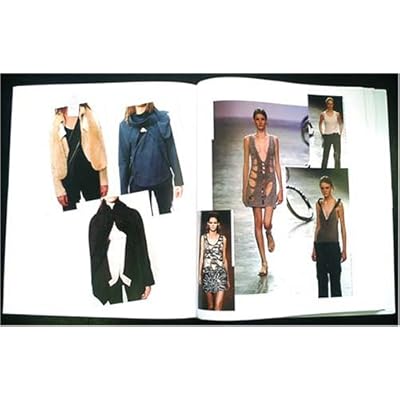
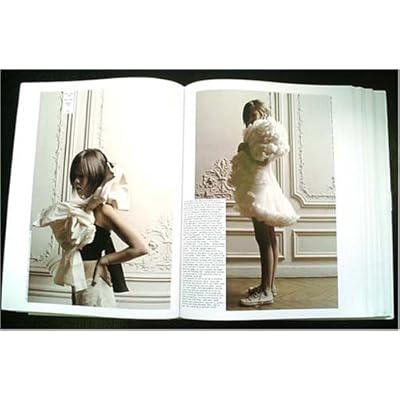
If you are looking for a good fashion book for yourself or as a present, check out Sample: 100 Fashion Designers - 010 Curators - Cuttings From Contemporary Fashion. Never mind the winding academic title - it's a wonderful, informative, and well-edited book. The curators are a bit skewed (Alexander McQueen picks only British designers, for example), but the selection is decent nonetheless. There are some cool blurbs on Carol Christian Poell, Shaun Leane, etc. It was just released in paperback, and for under $30 it's just about the best fashion book one can own. And in case you feel like splurging, I suggest the hardcover version (that's the one I own) - after all, it did not get the I.D. magazine honorable mention in graphics (2006) for nothing.
soft cover
hard cover